The psilocybin gut microbiome connection has picked up sudden interest online, mostly thanks to social posts summarizing a handful of new studies. Strip away the framing and there are exactly three sources worth looking at on the psilocybin gut microbiome question: one preclinical mouse study, one in-vitro lab fermentation study, and one review. None of them tested psilocybin’s effect on a living human gut. Here’s what each one actually measured, and why two of them point in opposite directions.
Some links in this article are affiliate links. If you buy through them, we may earn a commission at no extra cost to you. See our affiliate disclaimer.
The Gut-Brain Axis, Briefly
Before getting into the psilocybin gut microbiome research, it helps to know the background it sits on. The gut and the brain communicate constantly through the vagus nerve, immune signaling, and chemical messengers that gut bacteria help produce — including precursors to serotonin. This two-way channel is called the gut-brain axis, and it’s a legitimate, well-established area of neuroscience independent of psychedelics.
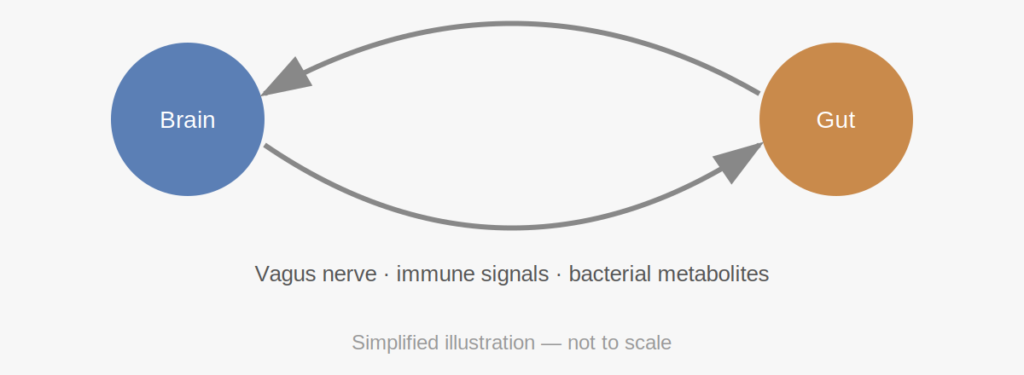
Because psilocybin acts heavily on serotonin receptors, and because a large share of the body’s serotonin activity involves the gut, researchers have started asking whether psilocybin might also shift gut bacteria — and whether that shift feeds back into its effects on mood or behavior. That question is still open. The psilocybin gut microbiome studies below are early attempts to answer it, not confirmation of an answer.
What an Animal Study Found About the Psilocybin Gut Microbiome
The most rigorous psilocybin gut microbiome source is a 2025 study in Neuropharmacology that gave mice repeated oral psilocybin doses (0.1 mg/kg or 1 mg/kg, five days a week for six weeks) and then sequenced their gut bacteria. This wasn’t a one-off dose — it was a chronic protocol, closer to how a supplement or medication would actually be taken over time, which is one reason it carries more weight than a single-exposure design.
What’s been studied: In male mice without any disease model, the higher psilocybin dose (1 mg/kg) increased sociability and reduced startle response, and it also lengthened gut transit time in a dose-dependent way. On the microbiome side, researchers found a drop in three specific bacterial species — Lactobacillus murinus, Lactobacillus animalis, and Alistipes dispar — but only in male mice without the OCD-like gene deletion used in the study. Female mice and mice with the gene deletion showed no such psilocybin gut microbiome change.
What it doesn’t prove: This is a mouse gut, not a human gut, and the sex- and genotype-specific nature of the result means it may not even generalize across all mice. Six to eight animals per group is a normal preclinical sample size, but it’s small enough that a replication with more animals could easily shift the numbers. The authors did link these bacteria to behavior through correlation analyses in a 12-mouse subset, but the correlations reported were not corrected for multiple comparisons, and the study didn’t test whether the psilocybin gut microbiome change caused the behavioral change or was simply a parallel effect of the same serotonin pathway.
What a Lab Fermentation Study Found
A second, very different psilocybin gut microbiome study, published in Drugs and Drug Candidates in 2026, used a machine called SHIME — a benchtop system that simulates the human colon using real fecal bacteria from human donors, without any live human or animal involved. Researchers added a Psilocybe cubensis mushroom extract (about 35 mg/L of psilocybin) to fecal samples from three people with severe anxiety and tracked how the bacterial community responded over 15 days of treatment.
What’s been studied: In this lab environment, Bifidobacterium and Lactobacillus — the same genus that dropped in the mouse study — actually increased. Short-chain fatty acids linked to gut health rose roughly 2 to 3-fold, and ammonia, a waste product, fell by about 19–25%. The results weren’t uniformly positive, though: GABA levels went down, overall diversity dipped slightly, and the immune markers moved in mixed directions (IL-6 fell while TNF-α rose). The authors read the fatty acid and ammonia changes as a shift toward a more carbohydrate-fermenting, less proteolytic environment, while describing the immune response as complex rather than uniformly anti-inflammatory.
What it doesn’t prove: This was one experimental run (not repeated), with no brain, no whole-body immune system, and no behavior — just human gut bacteria in a machine, exposed to a whole mushroom extract rather than purified psilocybin. The authors themselves state that the findings do not establish any clinical benefit for gut or mental health. It’s also worth noticing that the Lactobacillus result runs in the opposite direction from the mouse psilocybin gut microbiome study.
Why the Two Studies Disagree
This is the part most social media summaries skip, and it’s the most useful part for understanding where psilocybin gut microbiome science actually stands right now.
| Study | Model | Lactobacillus effect | Sample size |
|---|---|---|---|
| Gattuso et al., 2025 | Live mice, chronic oral dosing | Decreased (male WT only) | 6–8 mice per group |
| Salgaço et al., 2026 | In-vitro colon simulator | Increased | 1 experimental run, 3 donors |
A living mouse has a nervous system, hormones, an immune system, and an intact gut lining feeding back into its bacteria in real time. A fermentation machine has none of that — it’s bacteria reacting to a compound in isolation. Both are legitimate ways to study a question, but they’re not measuring the same thing, and right now nobody has run the human-equivalent psilocybin gut microbiome study that would settle which pattern — if either — holds up in a person. A 2023 review proposed that gut bacteria could plausibly play a role in how psilocybin therapy unfolds over time, but it offered no new data of its own — it’s a hypothesis paper, not evidence.
Legal and Safety Context
Psilocybin remains illegal for personal use in most of the US, the UK, and most other jurisdictions. That status hasn’t changed because of this research, and none of the psilocybin gut microbiome sources above involved dosing a human being. For that reason, this article contains no dosing information, no sourcing information, and no protocol of any kind for psilocybin. If you’re looking into the gut-brain axis for reasons unrelated to psychedelics, that’s a separate and much more actionable topic — see our guide on natural ways to support brain function.
Legal Alternatives for Cognitive Support
Legal nootropics are not substitutes for psilocybin, and nothing in the research above suggests they produce the same effects. Their evidence has to be judged on its own.
Why We’d Choose It
If your actual interest is cognitive performance rather than the microbiome question itself, a legal product at least removes the legal risk. We’d look for three things: a fully disclosed label with no proprietary blends, no stimulants that could mask fatigue rather than address it, and a money-back guarantee. Mind Lab Pro is the option on this site that meets those three criteria — check current pricing here.
FAQ
Does psilocybin change gut bacteria?
In male mice given repeated doses, yes — certain Lactobacillus species dropped. In an isolated lab fermentation using human gut bacteria, the same genus increased instead. No human study has directly tested the psilocybin gut microbiome effect yet, so there’s no confirmed answer for people.
Is the gut-brain axis a real thing, or is this speculation?
The gut-brain axis itself is a well-established, mainstream area of neuroscience unrelated to psychedelics. What’s speculative is specifically how psilocybin interacts with it — that part is genuinely early-stage.
Can microdosing psilocybin improve gut health?
There’s no psilocybin gut microbiome study that has tested microdosing specifically for gut health outcomes in humans. The two studies covered here used either a chronic protocol in mice or a single extract exposure in a lab simulator — neither is a microdosing study.
Is Lion’s Mane combined with psilocybin (the “Stamets stack”) backed by gut research?
No. None of the studies discussed here tested Lion’s Mane in combination with psilocybin. That combination is a popular idea in psychedelic communities, but it hasn’t been tested for gut microbiome effects specifically, and we’re not covering dosing protocols for it here.
Were any of these studies done in living humans?
No. The mouse study used live animals, and the lab study used bacteria from human donors inside a colon simulator, but no person was given psilocybin in either psilocybin gut microbiome experiment. The third source is a review, not an experiment.
Should I take psilocybin for gut health?
Nothing in this research supports that. The findings are preclinical or lab-only, psilocybin is illegal for personal use in most jurisdictions, and this site doesn’t provide dosing or sourcing information. If you have a gut or mental health concern, speak with a qualified healthcare provider.
Bottom Line
Right now, psilocybin gut microbiome research amounts to one small mouse study showing a decrease in certain bacteria, one lab-only fermentation study showing an increase in similar bacteria, and one review proposing the connection is worth studying further. That’s an interesting early direction for neuroscience, not a settled finding, and it isn’t a foundation for any health claim about gut health, mood, or cognition in humans. For a deeper look at what the human research on psilocybin and cognition actually shows, see our full breakdown of the psilocybin microdosing and creativity studies, or start with our nootropics for beginners guide if you’re new to this topic entirely.
This article is for informational purposes and is not medical advice. Speak with a qualified healthcare provider before making decisions about your health, and note that psilocybin is illegal for personal use in most jurisdictions.
Source studies: Gattuso, J.J. et al. (2025), Neuropharmacology, 279, 110648; Salgaço, M.K. et al. (2026), Drugs and Drug Candidates, 5(3), 46; Kelly, J.R. et al. (2023), Int. J. Clin. Health Psychol., 23, 100349.